The No-Lo Etiquette: What to Say When Someone Asks Why You're Not Drinking
The research-backed etiquette for the question every non-drinker gets asked -- and why the best answer is rarely a sentence at all.
At some point in nearly every evening where you're not drinking, someone will ask why. It rarely arrives with malice. More often it surfaces mid-conversation, almost as an aside — "wait, you're not drinking?" — delivered with the same easy curiosity as someone noticing you've ordered the same starter twice. And yet research into how non-drinkers experience these moments tells a more complicated story: in one study of university students, the overwhelming majority reported being on the receiving end of comments that labelled them "boring" simply for not drinking, and several described going out of their way — inventing excuses, avoiding events altogether — just to skip the question entirely. If a single, casually asked question is powerful enough to make people quietly opt out of social life, it's worth understanding what's actually being asked.
The Question Isn't Really About You
Researchers who study ritual behaviour describe shared drinking as a synchronisation ritual: everyone in the group performing roughly the same sequence — order, pour, raise, sip — at roughly the same time, which is part of how a group quietly signals its own cohesion to itself. What this means is that when one person's sequence visibly diverges — a different glass, an empty hand, a drink that arrived without the small ceremony everyone else's did — the group registers a break in its rhythm before it registers anything specific about the person who broke it. "Why aren't you drinking?" is, more often than not, the sound of a group noticing a gap in its own pattern, not a verdict on your choices. That reframing matters, because it changes what kind of answer actually works: not a justification, but simply something that closes the gap.
It's also why the question surfaces far more often at celebratory occasions — toasts, weddings, a round bought for the whole table — than at a quiet dinner for two. The more synchronised the ritual, the more visible any deviation from it becomes. At a relaxed dinner, nobody is consciously tracking anyone else's glass. At a toast, everyone briefly is, even if not one of them would describe it that way.
The Prop Effect: Solve It Before Anyone Speaks
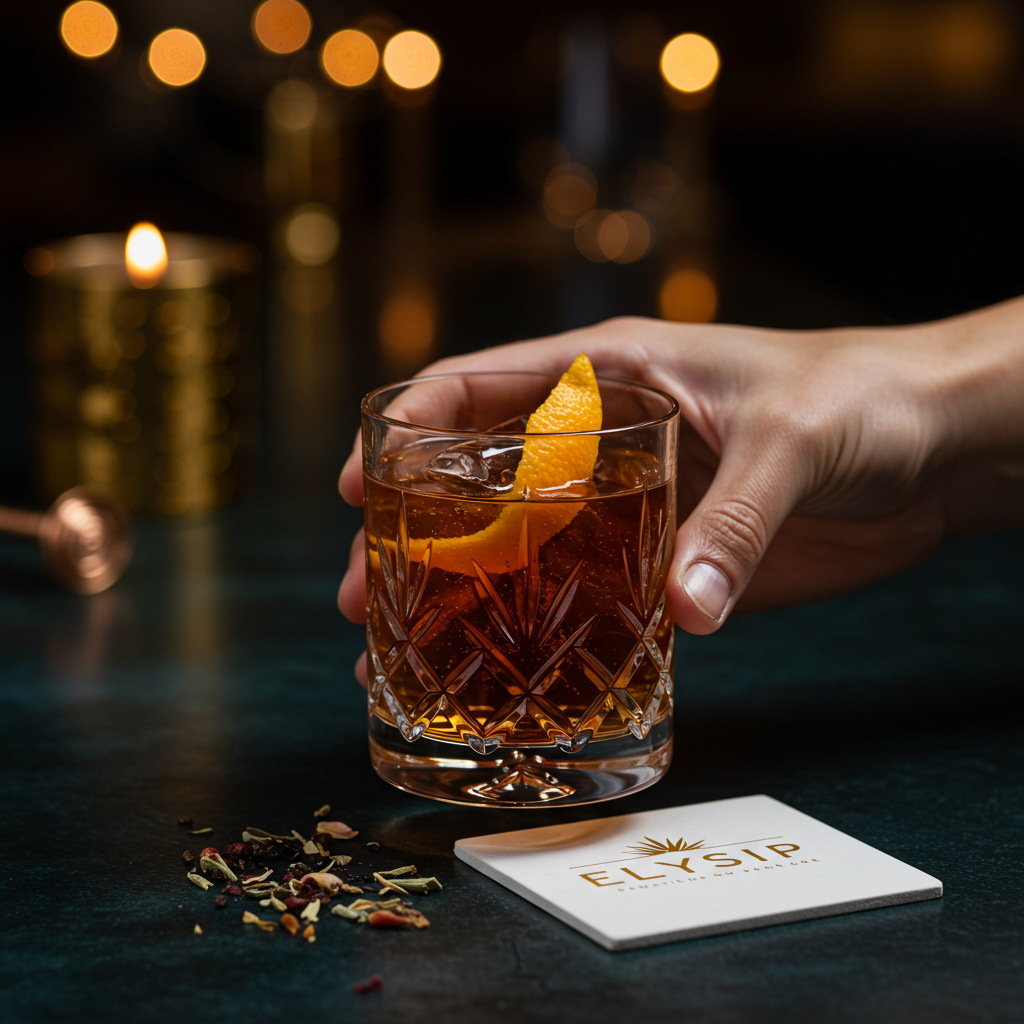
This is also why people who don't drink often report that having something in hand — almost regardless of what it is — changes how often the question gets asked at all. A glass with ice, a garnish, condensation on the outside, held the way a drink is normally held, restores the pattern the group is unconsciously tracking, before a single word is exchanged. The most effective etiquette tool, in other words, isn't a sentence prepared in advance. It's the glass in your hand, ordered with the same structure as everyone else's — which is precisely why how you order (a separate, related question entirely) does so much of this work before the evening has even properly started. Solve the visual first, and for most of the room, the question never forms in the first place.
Three Responses That Close the Loop — and Three That Open a Better One
When the question does come — glass in hand or not — the goal isn't to win an argument about alcohol, and it almost never needs to be a real conversation at all. It's to close the gap the group noticed, briefly and without friction, so the evening can move on to literally anything else.
- "Not tonight — I'm on the [name of your drink] instead." Specific, declarative, and framed as a choice rather than a restriction. Naming the drink does more work than any explanation could; it tells the room you made an active decision, not that you're managing an absence.
- "I'm pacing myself for later." True on more nights than people admit, and it reframes the moment as timing rather than abstinence — which tends to end the conversation immediately, because there's nothing left to ask.
- "Honestly, I just prefer this one tonight." The shortest of the three, and often the most effective, precisely because it offers nothing to push back against. Preference doesn't require defending.
And if you'd rather turn the moment into something more interesting than a non-event, all three of the following do that while still closing the loop:
- "Have you tried this? It's the one I've been ordering lately — properly bitter, built like a Negroni." Converts a question about your choice into an invitation about theirs.
- "This place does a non-alcoholic version that's better than half the cocktails on the list — want to try it?" Reframes the entire category as a recommendation, not a workaround.
- "I'm doing a no-alcohol stretch, but I refuse to drink badly while I'm at it." A little humour, and a clear statement that the standard hasn't dropped — only the ingredient has.
The ELYSIP Standard
The standard ELYSIP applies here is simple: never apologise for what's in your glass. Speak about it the way you'd speak about choosing a rare amaro over a more familiar spirit — with a little specificity, a little pleasure, and zero defensiveness. The moment an explanation starts to sound like an excuse, the room treats it like one, regardless of what's actually being said. Confidence about a choice reads as a choice. Hesitation about it reads as a problem, even when there isn't one.
The Verdict
The etiquette of not drinking was never really about finding the right words. The words matter least of the three things actually in play — what's in your glass, how it was ordered, and only then, occasionally, what you say about it. Solve the first two well, and the third rarely comes up at all. When it does, answer it the way you'd answer "where did you get that jacket?" — briefly, with a flicker of pride, and move straight on. The evening was never waiting on your answer. It just needed the rhythm restored.
The full Botanical Dinner Protocol — how to design an entire evening so this question almost never arises — is available to ELYSIP members.