
The Anatomy of Linalool: Molecular Seduction and Quietude
A masterclass in Linalool (C10H18O), exploring its 0.8 ppb olfactory threshold, GABA_A receptor modulation, and role in modern luxury alchemy.
At precisely forty-two degrees Celsius, the air grows heavy with an invisible, silver-hued weight. It is not the heat of combustion, but the cool release of volatile luxury. A scent that is simultaneously ancient and entirely modern drifts across the palate: lavender fields cooled by midnight rain, a soft trace of crushed bergamot, and the faint, wood-paneled quiet of a private library. This is the olfactory signature of suspension, a slow-motion descent into sensory stillness. The tongue registers no heat, only a velvet expansion of floral shadow, a quiet persuasion that commands attention without raising its voice. The noise of the day recedes, replaced by a deep, resonant stillness.
The Science Behind It
Linalool, chemically designated as C10H18O, is an unsaturated monoterpene alcohol that operates at the absolute frontier of human perception. With an exceptionally low olfactory threshold of just 0.8 parts per billion, its molecular presence is detected by the olfactory bulb long before the conscious mind can assign a name to its elegance. In premium No-Lo distillates, this compound requires delicate thermodynamic preservation to protect its highly volatile structure from degradation — a challenge that separates serious producers from commodity manufacturers.
Beyond its immediate sensory elegance, linalool engages in a sophisticated biochemical dialogue with the human nervous system. Neurochemical studies indicate that linalool acts as a modulator of the GABA_A receptor complex. By enhancing GABAergic transmission, it coaxes the brain's overactive neural pathways into a state of elegant deceleration. This is not sedation in the traditional pharmaceutical sense, but rather a refining of the cognitive frequency — a molecular filter that removes environmental noise to reveal a state of lucid focus. The compound also exhibits a subtle antagonism at NMDA receptors, further tempering glutamate-induced excitation.
Stereochemistry plays a critical role here. The (R)-(-)-linalool enantiomer possesses a far more refined, woody-lavender olfactory signature compared to its synthetic counterparts. Premium producers who source and isolate this specific enantiomer deliver a sensory reception that is clean, direct, and free of chemical dissonance — a distinction invisible on the label but immediately legible on the palate.
The Ritual
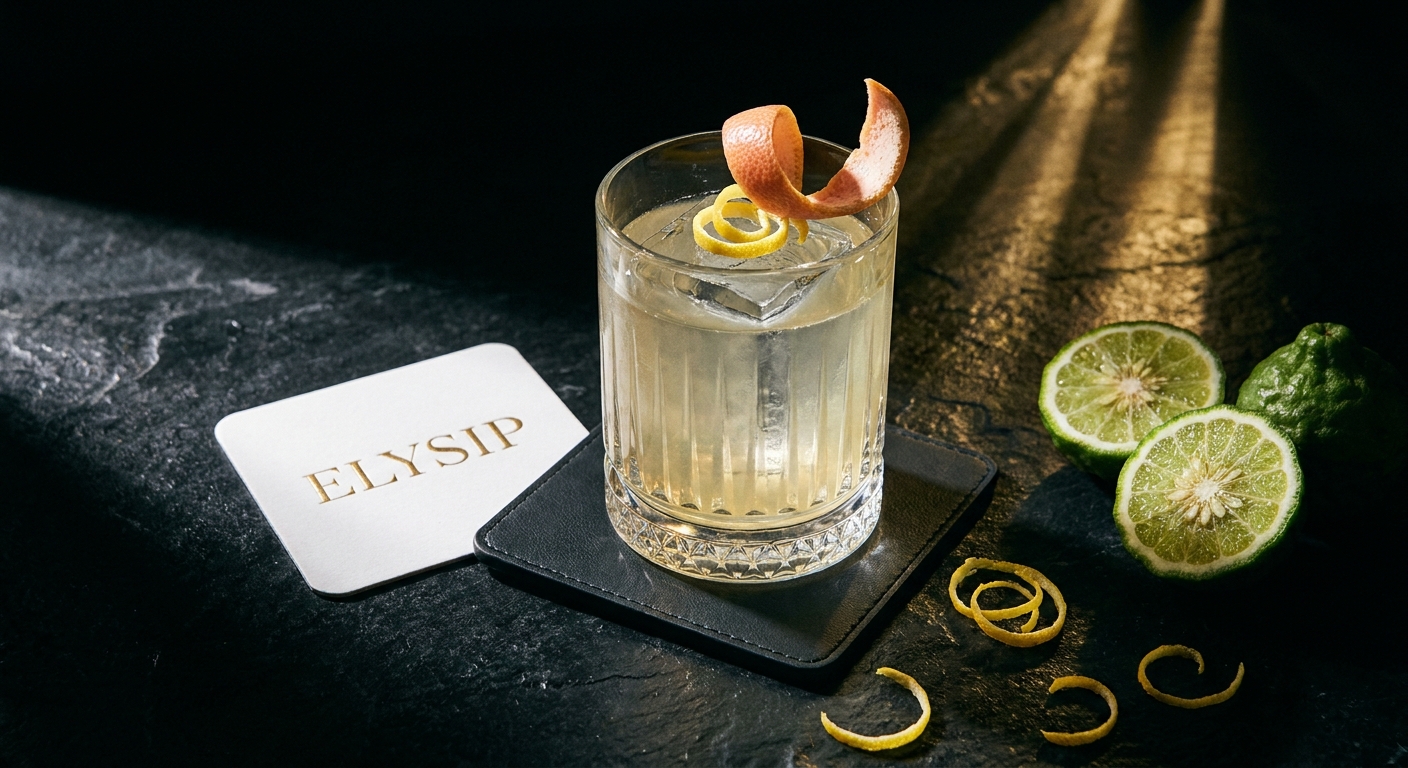
To experience the true depth of linalool in a premium No-Lo distillate, the ritual demands deliberate thermal precision. Serve forty-five milliliters chilled to exactly eight degrees Celsius over a single, hand-carved sphere of ultra-dense ice. The density of the ice ensures a slow, controlled dilution, preserving the delicate monoterpene matrix. As the liquid cascades over the sphere, the release of linalool is gradual, rising in quiet waves that evolve over twenty minutes.
Pair with a premium, low-sugar tonic water, poured gently along the spiral of a bar spoon to maintain carbonation integrity. The effervescence serves as a kinetic vehicle, lifting the volatile linalool molecules directly to the rim of the glassware. Do not garnish with citrus peel — aggressive limonene overwhelms the delicate floral-soft terpene profile. Instead, use a single sprig of dried French lavender, gently bruised between the fingertips to awaken its surface terpenes. Select a tapered crystal tulip glass to concentrate the volatile headspace, allowing the delicate aromatics to gather at the narrow opening.
The Ingredient Spotlight
The finest linalool profiles in No-Lo distillation are built on Lavandula angustifolia, harvested at dawn in high-altitude European sanctuaries where the soil yields a terpene density of exceptional purity. The extraction method is decisive. Mass-market producers rely on harsh thermal distillation, which degrades the delicate co-presence of linalyl acetate — the ester that lends linalool its characteristic soft, woody-floral undertone. Advanced producers employ hydrodynamic cavitation or supercritical CO2 extraction to isolate the monoterpene without thermal damage, preserving the molecular architecture intact.
The difference is immediate on the palate. High-altitude linalool, properly extracted, delivers a complex, multi-dimensional floral-soft experience: a bright, herbaceous snap at entry, quickly melting into a soothing, creamy lavender note that lingers at the back of the throat. Lower-grade extractions register as soapy, flat, or artificially floral — the chemical fingerprint of thermal compromise.
In a world that demands constant amplification, luxury is defined by the decision to quiet the room. Linalool is the molecular key to this deliberate stillness. It does not demand attention through force — it seduces the senses with whispering elegance. A glass built around linalool is an act of intellectual luxury, a space where molecular science and sensory beauty meet in perfect, quiet harmony.