
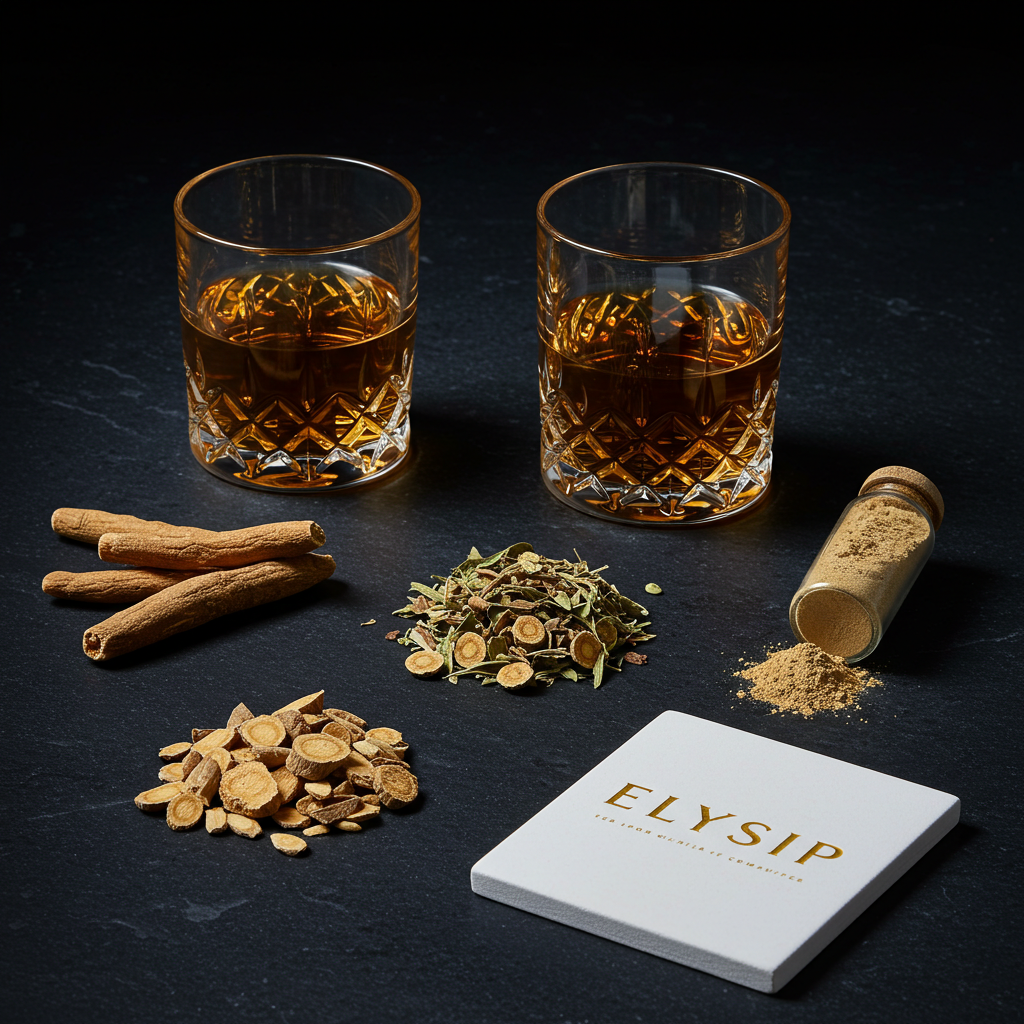
Nootropics in Your Drink: Dosages, Safety and Molecular Combinations
ELYSIP Codex deep dive: the four nootropic and adaptogenic compounds in luxury functional cocktails, with clinical dosage data, safety profiles, and the terpene amplification matrix.
The luxury beverage industry has adopted the language of nootropics with the same enthusiasm it once applied to "terroir" and "provenance" — evocative, premium-coded, and frequently undefined. A term that entered the scientific literature in 1972 to describe compounds that enhance cognitive function without toxicity has been progressively diluted into a synonym for "functional ingredient with an interesting name." The result is a category where the word "nootropic" appears on labels ranging from clinically serious formulations to drinks containing a nominal dusting of lion's mane. The ELYSIP Codex approach requires precision: not the language of nootropics, but the science of them — mechanisms verified, doses declared, interactions mapped. This entry covers the four primary adaptogenic and nootropic compounds in serious functional cocktail formulation. It is premium content because the detail here — specific doses, bioavailability differentials, safety thresholds, interaction architecture — is the information that separates a purchasing decision from a marketing response. Read it as a technical dossier, not a category overview.
Bacopa monnieri is the most robustly studied botanical nootropic in the clinical literature, and the least glamorous — a creeping herb from Indian wetlands with no luxury associations and a slow, demanding mechanism. Its active compounds, bacosides (triterpenoid saponins), operate through three simultaneous axes: activation of choline acetyltransferase, the enzyme responsible for acetylcholine synthesis, which is the neurotransmitter most directly involved in memory encoding and retrieval; vasodilation via nitric oxide release, producing an estimated 25% increase in cerebral blood flow; and upregulation of antioxidant enzymes — SOD and catalase — that reduce oxidative stress in hippocampal tissue. The cognitive outcome is measurable. Meta-analysis positions Bacopa as producing the largest effect sizes among botanical nootropics on verbal learning tasks, with Cohen's d values up to 1.01 in well-controlled trials — a figure that exceeds both Panax ginseng and modafinil in specific memory domains. The clinical effective range is 300–450 mg of standardised extract standardised to 55% bacosides, taken daily. The critical caveat: onset requires 12 weeks of consistent use. There is no acute Bacopa effect. A single-serve drink containing Bacopa is a formulation philosophy and a systemic signal, not a pharmacological event within the session. The correct framing for the discerning consumer: a brand that includes Bacopa at a declared dose is demonstrating a commitment to the compound's mechanism and the drinker's long-term cognitive environment. That commitment is the luxury proposition — not an immediate effect.