Theanine and Hops: The Chemistry of Relaxed Alertness
L-theanine induces alpha brainwaves. Hops deliver linalool to the same GABA-A receptors. The science behind the non-alcoholic drink that actually relaxes you.
There is a state — familiar to anyone who has had a perfect cup of matcha at altitude, or the first evening glass in a truly quiet room — where the mind is both still and sharp. Alert without tension. Present without effort. Not the blunted calm of alcohol, which produces its apparent relaxation by suppressing the very faculties that make an evening worth having. Something more precise: the cognitive condition in which conversation flows, attention holds, and the evening has weight without effort. Neuroscience has a term for the brainwave pattern that underlies this state: alpha. It sits in the 8–12 Hz band, associated with calm focus and creative readiness, and it is the least-discussed and most desirable target in functional beverage formulation. The two molecules best positioned to induce it within a non-alcoholic cocktail format are L-theanine and linalool — the latter found in significant concentration in hops. This is how they work, why the combination is not accidental, and what to look for in any drink that claims to deliver it.
L-Theanine: The Alpha Inducer
L-theanine (γ-glutamylethylamide) is an amino acid found almost exclusively in green tea leaves, accumulating in greatest concentration in shade-grown varieties where reduced UV exposure triggers its biosynthesis. It is one of the better-studied compounds in the functional food literature, with a mechanism that is unusually legible for a botanical ingredient. Unlike classical sedatives or anxiolytics, L-theanine does not slow cognition. It modulates GABA pathways, inhibits excitatory glutamate activity, and reduces cortical arousal — without inducing drowsiness. What this produces, measurable in EEG studies, is increased power in the alpha frequency band: the signature of a brain that is calm and attentive simultaneously. In plain terms: the mind quiets without going offline. The tension leaves without taking the focus with it.
The Dose Question
As with every functional botanical, the dose is where the marketing typically diverges from the mechanism. The clinical literature on L-theanine's alpha-inducing effects uses doses in the range of 100–200 mg per serving, administered as a standardised extract. Most functional beverages that list L-theanine on the label contain a fraction of this — often 25–50 mg, occasionally less, rarely disclosed. A 2025 study involving over 1,000 participants using an L-theanine-fortified non-alcoholic formula found that 71% reported increased relaxation and 88% reduced their alcohol consumption during the trial period. What the study does not tell you, and what the brand almost certainly will not volunteer, is the dose per serving. That number is the entire argument. A producer who publishes it is making a claim the molecule can support. A producer who lists L-theanine in the ingredient deck without standardisation data is listing an amino acid and invoking a research canon that their product has not earned.
Hops and Linalool: The Botanical Bridge
Humulus lupulus — hops — entered the no-lo industry through the back door of craft brewing, initially as a bittering agent that gave non-alcoholic beer its structural credibility. What the more technically rigorous end of the category subsequently identified is the terpene profile of the lupulin gland: hops are rich in linalool — also found in lavender, coriander, and certain rose varieties — as well as myrcene and beta-caryophyllene. Linalool's mechanism is direct: it acts on GABA-A receptors, the same receptor class modulated by L-theanine and, at higher concentrations, by classical anxiolytics and alcohol itself. The pharmacological interaction with L-theanine is complementary rather than merely additive. L-theanine operates upstream in the neurotransmitter synthesis and reuptake pathway; linalool acts at the receptor level. Two different molecular routes converging on the same physiological destination. This is what a serious formulator means by synergy — not a marketing claim, but a mechanistic argument for why the combination outperforms either compound in isolation.
The Brewing Connection
The bitterness of hops in classical brewing has always carried a secondary function beyond flavour architecture: the alpha acids and terpenes concentrated in lupulin glands produce mild sedation at meaningful concentrations. Pre-industrial European physicians prescribed hop pillows for insomnia — a folk application that predates the identification of linalool by centuries but points at the same molecular mechanism. The craft no-lo industry's rediscovery of hops as a functional ingredient rather than a bittering agent is, in this sense, pharmacobotany completing a circle that empirical tradition opened long before the laboratory named the compound. What changes with a rigorous formulation approach is precision: the terpene fraction isolated, the linalool content standardised, the L-theanine dose calibrated against clinical evidence, the combination tested for flavour compatibility rather than assembled from separately sourced ingredients that happen to share a mechanism.
Reading the Label: Three Checks
For any L-theanine and hops drink that commands a premium, the ELYSIP Codex applies the same three-point scrutiny it applies across every functional category. First, L-theanine dose per serving: it must be declared, and it must be in the 100–200 mg range to have a plausible claim on the alpha-state mechanism. Anything below 50 mg is decoration. Second, hops extract specification: the linalool content or the terpene fraction should be stated. Whole hops, hop powder, and hop extract with a declared linalool percentage are meaningfully different ingredients; the label should tell you which you are drinking. Third, interaction compatibility: L-theanine and linalool both modulate the GABA system; at the doses relevant to functional beverages this is complementary and well-tolerated, but the brand should demonstrate awareness of the mechanism rather than using both ingredients as separate label claims with no acknowledgment of the combined action. Transparency at this level is the difference between a formulator and a label designer.
The Architecture of Relaxed Alertness
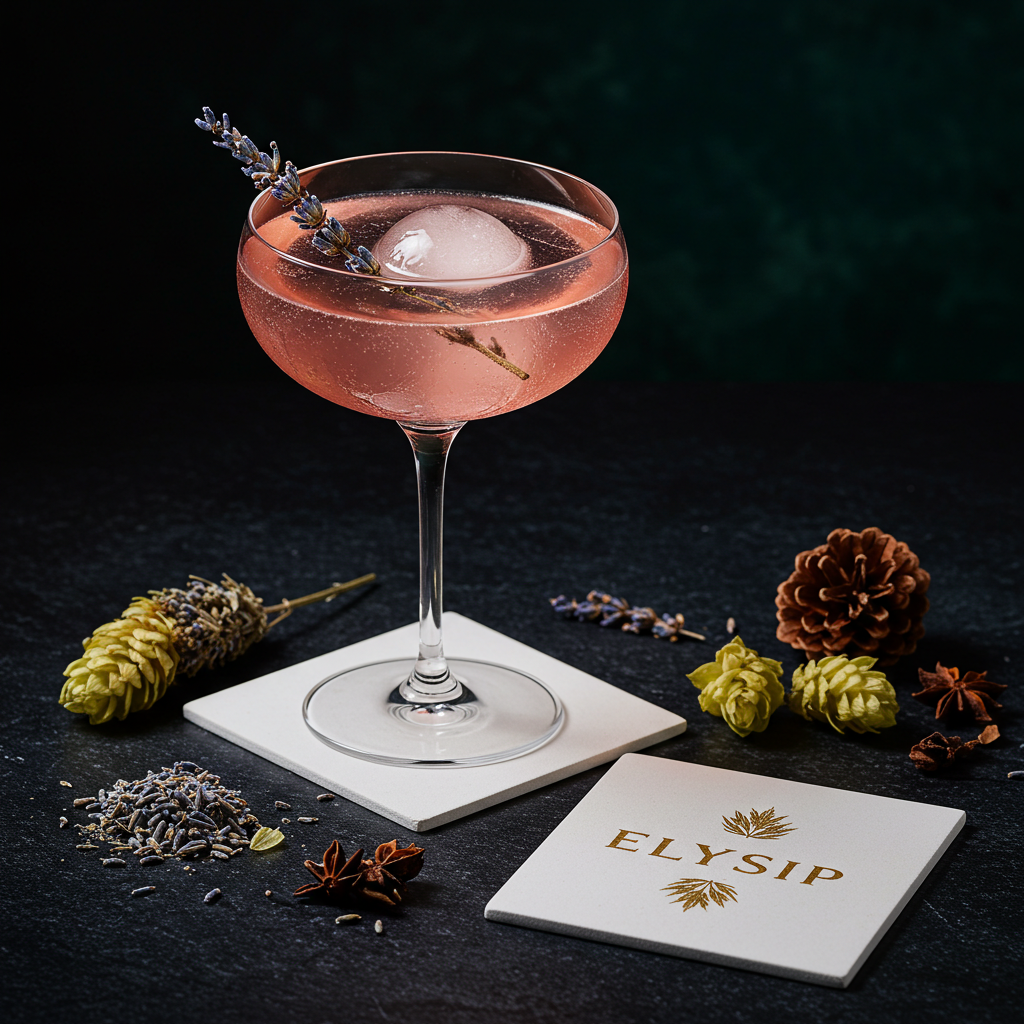
The sensory brief for this molecular target is not complicated, but it is specific. The alpha state sits at the intersection of calm and attentiveness — it is not the warm sedation of chamomile tea or the anaesthetic descent of a second glass of wine. The correct aromatic cue is therefore not warm-heavy but cool-precise: lavender, which contributes linalool from a different botanical source and reinforces the terpene signal; a hop-forward base that provides bitterness as structural anchor; effervescence that lifts without disrupting. The glass as cognitive architecture — a sensory environment calibrated to support the mental state the molecules are inducing. Served over a single sphere of ice in a crystal coupe, garnished with dried lavender and a pressed edible violet: the aesthetics are not incidental. They are the final argument that the drink is a decision, not a supplement. For the full Relax Protocol — exact measures, sourcing specifications, and the extract standards that pass the Codex — the complete recipe is available to ELYSIP members.
The Verdict
The L-theanine and hops combination is the most scientifically coherent pairing in the functional aperitivo category: two compounds with complementary mechanisms, a well-characterised shared target, and an unusually strong consumer evidence base for L-theanine specifically. The failure mode is the same as every functional category — under-dosing and non-disclosure — and the tells are identical: no mg figure for L-theanine, no linalool specification for the hops extract, no acknowledgment of the mechanistic relationship between the two. A drink built to the standard the science supports will declare both. A drink that lists "L-theanine" and "hop extract" without numbers is borrowing a research canon to which its formula has not been admitted. The alpha state is real, reproducible, and worth paying for. The question is only whether the drink in your hand has actually been built to produce it.